
Drawing a Male Nude

Having established an outline of the structure and light, I merely have to consult the original sketch to to give a fuller definition to the shadows.
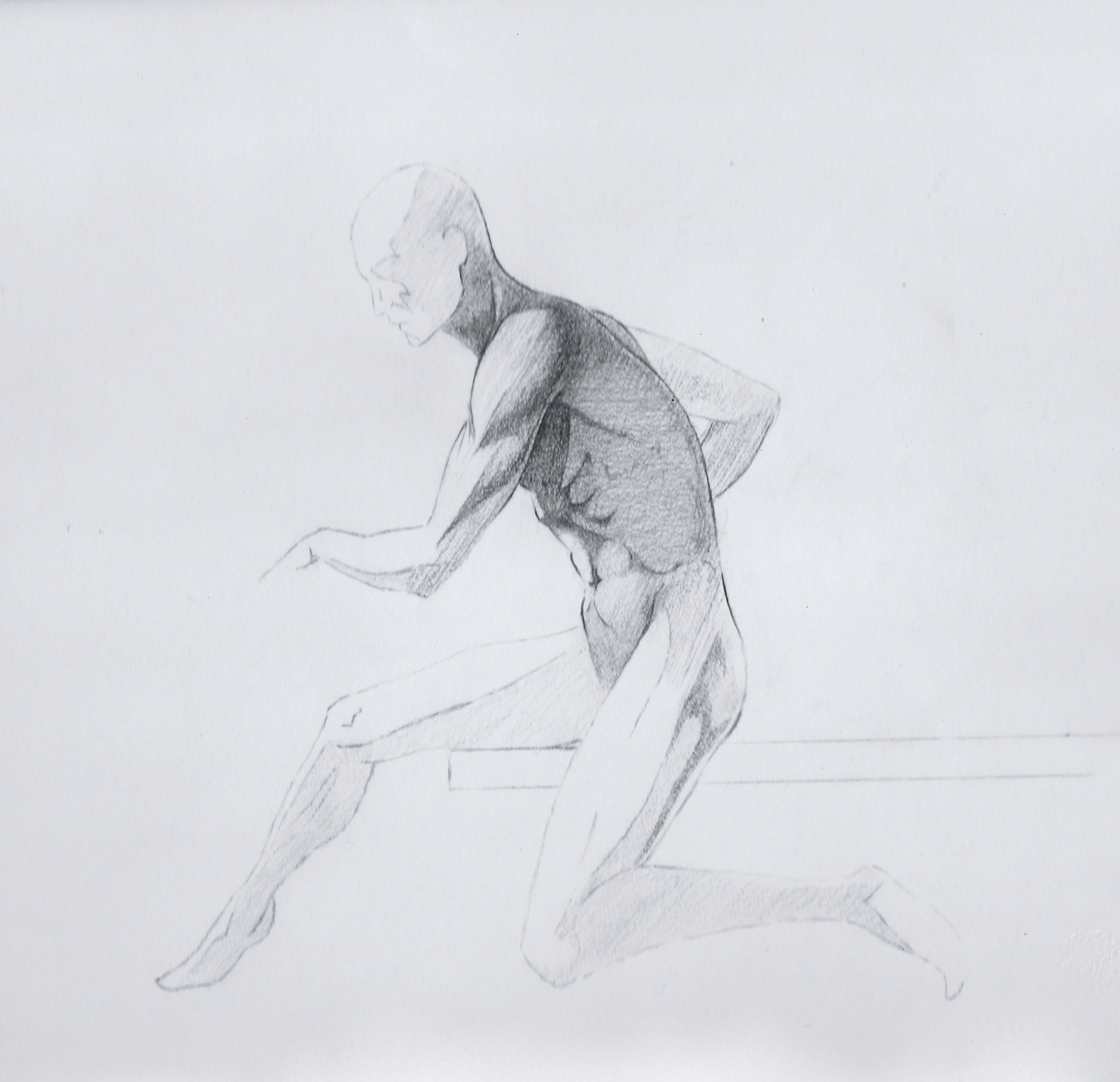
I begin shading at the figure's left arm and move outward across the torso. I do not yet bring out the darkest darks, because I may need to make erasures later. 

Below, I continue shading outwards from the center. I have established by now all the basic muscular  and skeletal forms to be fleshed out. I try to do this with a fluent hatching stroke to avoid making prominent lines in the interior of the figure.  Besides giving a convincing roundness to the form, it also puts an added emphasis on the harshness of such lines that I do want to feature, such as those in the deltoid and triceps. This allows me to stress angularity without sacrificing realism. 
If you click on any of the images for a close up view, you will see that my hatching is done in largely uniform direction. This is a choice that grew out of starting shading on the figure's left arm. This stroke was a natural choice in this regard, and I found that by continuing it across the figure, I could produce a rhythm, of which the sharp lines of the arm are a kind of climax. The only cross-hatching is in the torso, where it is fine enough to be imperceptible. 


Comments

Popular posts from this blog

Giuseppe Arcimboldo and the Double Image

Giuseppe Arcimboldo (1526 – 1593) was an Italian Renaissance painter famous for his imaginative and unconventional portraits. Born in Milan, he served as a court painter for the Habsburg emperors in Vienna and Prague. Arcimboldo's unique style is characterized by his "composite portraits" which used a combination of objects, fruits, vegetables, and other elements, arranged to portray a human face. These whimsical and highly detailed works are often interpreted as allegorical representations of the seasons, elements, or human attributes. The Four Seasons  1563-73 Arcimboldo's most famous series of paintings is "The Four Seasons"  where he cleverly arranged items like flowers, fruits and branches to capture his enigmatic visages. Today, Arcimboldo is popularly known primarily for his influence on the surrealists. But Arcimboldo's influences is more far-reaching than that. From the chalk cliffs of Germany to the American Southwest, Arcimboldo has helped sha...

How to Paint a Landscape in Oil

This is a landscape painted with oil on paper. It was painted from a photograph and the subject is a pond in Central Park. The visual theme is "distance" and all of my choices were made in order to communicate and stress the illusion of space.  The painting was made in four layers, with a few days between each one to allow the paint to dry. I am going to describe the process of each layer. STEP 1 The first step is to block in the large shapes. This is a means of mapping out the composition, choosing which objects will be included and which omitted. The exact tones used at this stage are not absolutely critical but are an approximation of the target colors. Since they will serve as a substrate for subsequent layers, I mixed them lighter and duller than my target colors. That way they won't dominate subsequent layers by showing through and altering the color of those layers—at least no more than I want them to. STEP 2 The next layer of paint is ...

Drawing a Male Nude

I began this project with a sketch from a live model. This was done quickly and roughly, as a mere practice exercise. My goal was basically naturalistic—to record the body of the model in the pose that he had chosen. However, I emphasized certain elements that I found striking. The angularity of the shadows produced by multiple lights sources; the separation of the muscles into rotund masses; the elongation of the limbs; these were all spontaneous stylizations suggested by the model's body. These were what made me want to develop the sketch further The first step was to identify what I liked about the drawing and the pose, and to distinguish these from what was accidental and irrelevant.  I did this by laying tracing paper over the original sketch and manipulating various aspects of the figure to see which elements were essential and which could be changed. I found that I liked the twist of the body and that this could be emphasized by adjustments of the ...