Giuseppe Arcimboldo (1526 – 1593) was an Italian Renaissance painter famous for his imaginative and unconventional portraits. Born in Milan, he served as a court painter for the Habsburg emperors in Vienna and Prague. Arcimboldo's unique style is characterized by his "composite portraits" which used a combination of objects, fruits, vegetables, and other elements, arranged to portray a human face. These whimsical and highly detailed works are often interpreted as allegorical representations of the seasons, elements, or human attributes.
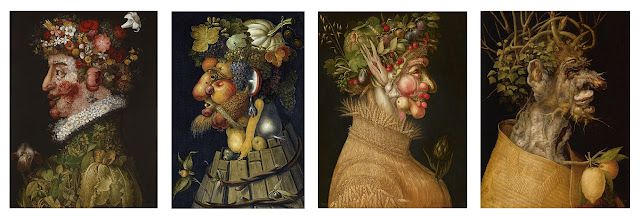
Arcimboldo's most famous series of paintings is "The Four Seasons" where he cleverly arranged items like flowers, fruits and branches to capture his enigmatic visages. Today, Arcimboldo is popularly known primarily for his influence on the surrealists. But Arcimboldo's influences is more far-reaching than that. From the chalk cliffs of Germany to the American Southwest, Arcimboldo has helped shape the visual arts of the western world.
CASPAR DAVID FRIEDRICH
While Caspar David Friedrich and Giuseppe Arcimboldo belong to different artistic periods and schools, there are some shared themes and ideas that connect their work. Both artists had a deep appreciation for nature, employed rich symbolism related to nature, and developed highly individualistic styles that set them apart from their peers. While Friedrich's work was predominantly focused on landscapes, his approach to nature and symbolism can be seen as indirectly influenced by the idiosyncratic and allegorical elements found in Arcimboldo's art. But more explicitly, Friedrich was engaged in the same sort of pastiche image making, combining individual objects together to form a larger whole, a Double Image.

Friedrich's Winter Landscape shows his double image approach in the fir trees that echo the shapes of the distant cathedral, forming a "temple of nature."

While Friedrich's use of the double image is more subtle and less whimsical than Arcimboldo's, the same essential method is employed. The artists bury one image inside of another in order to express two meanings at once. This is similar to the double meaning in literature, where metaphor or simile perform the same function.
EDGAR ALWIN PAYNE
A similar approach to Friedrich's is found in the American Southwest, in the art of Edgar Alwin Payne. In "The Rendezvous" Payne portrays a boating party stopped on the shore to picnic. But buried in this quotidien subject matter is a panoply of fantastic imagery. The giant rock above their heads forms the shape of the back, tail, and hind legs of a giant beast or dragon emerging from the water, suggesting a rugged danger in the environment. But the casual attitudes of the figures and the benevolent colors of the sky and water suggest a confidence that knows no fear. Look even deeper, and you'll see a light show projected on the rock to the upper right, like a film reel playing an endlessly transforming phantasmagoria of images of farm life, adventure, horse riders, all the elements of American frontier life that these foreign journeyman have to look forward to.
 Edgar Alwin Payne, The Rendezvous ca. before 1947
DALI
Arcimboldo's unconventional approach to portraiture and his ability to blend disparate elements to create unexpected and dreamlike imagery resonated with the Surrealists. Artists like Salvador Dalí and René Magritte drew inspiration from Arcimboldo's playfulness and the idea of transforming everyday objects into something unusual and thought-provoking.
His influence on Salvador Dalí, the renowned Surrealist artist, is singular and profound. Dalí was fascinated by Arcimboldo's imaginative and unconventional style of portraiture, which played a significant role in shaping his own artistic vision. Today we are all familiar with Dali's method of juxtaposing and transforming objects and elements to create new, unexpected images.


Dalí was known for his ability to create bizarre and provocative juxtapositions in his paintings, and he drew inspiration from Arcimboldo's playfulness with visual transformation. Dalí's fascination with optical illusions and distorted realities can be linked to Arcimboldo's ability to create composite images that deceive the viewer's perception. Both artists challenged the way viewers perceive and interpret images, provoking a sense of wonder and intrigue.

Arcimboldo's whimsical approach to image making is a unique pleasure and his detail and depth allow for endless hours of exploration. His influence is still felt in the world today and I'm glad for it. The artists he influenced are some of my favorites and I've even incorporated his methods into my own work by way of Caspar David Friedrich's influence.

Comments
Post a Comment